
Understanding .DAT Files
;DAT files are generic data containers, often encountered in legacy systems and games; conversion to PDF depends heavily on the file’s internal structure and encoding.
These files frequently contain data in a compressed format, potentially utilizing zlib, or even already being a CFL file disguised with a .dat extension.
Successfully converting a .DAT file requires identifying its specific origin and the software that created it, as there’s no universal .DAT format.
What is a .DAT File?
.DAT files are remarkably versatile, yet fundamentally ambiguous, data containers. They aren’t tied to a specific application or file type, making their purpose context-dependent. Essentially, a .DAT file simply holds data – the challenge lies in understanding what data and how it’s organized.
Often, these files are remnants of older software or gaming systems, storing configuration settings, game levels, or other application-specific information. The extension itself provides minimal clues; it’s more of a generic placeholder. Many times, a .DAT file is actually a CFL file simply renamed with the .dat extension.
Because of this lack of standardization, opening a .DAT file directly often results in gibberish. Determining the correct method for viewing or converting a .DAT file to a more readable format, like PDF, requires investigation into its origin and potential encoding.
Common Uses of .DAT Files
.DAT files appear across a surprisingly broad spectrum of applications. In gaming, they frequently store level data, character information, or configuration settings crucial for gameplay. Legacy applications often utilize them for storing user preferences or application states, offering a simple method for data persistence.
Beyond these, .DAT files can be found holding data related to specific software, acting as repositories for various types of information. Some are even used as temporary files during software installations or updates. The need to convert these to PDF often arises when accessing information from discontinued or unsupported programs.
Understanding the original software is key; without it, deciphering the .DAT file’s contents and converting it to a usable format becomes significantly more challenging.
.DAT Files and Data Storage
.DAT files represent a rudimentary approach to data storage, often lacking inherent structure or metadata. This simplicity makes them versatile but also opaque; their contents aren’t self-describing, requiring external knowledge to interpret. Data within can range from plain text to binary code, and frequently employs compression techniques like zlib to reduce file size.
The lack of standardization means a .DAT file’s internal organization is entirely dependent on the creating application. This poses a significant hurdle when attempting conversion to PDF or other formats.
Essentially, a .DAT file is a container; understanding what is stored and how it’s organized is paramount for successful data extraction and conversion.

Methods to Convert .DAT to PDF
Conversion strategies include dedicated .DAT viewers, text editors for simple files, and online tools; 7-Zip can parse some, while hex editors allow manual inspection.
Using Dedicated .DAT Viewers/Converters
Dedicated .DAT viewers and converters represent the most straightforward approach, though finding a suitable one can be challenging due to the file’s generic nature. These tools attempt to interpret the internal structure of the .DAT file, presenting the data in a human-readable format.
Unfortunately, a universal .DAT viewer doesn’t exist; success hinges on identifying the software that originally created the .DAT file. If known, searching for a viewer specifically designed for that application is crucial. Some specialized converters might handle specific .DAT formats, particularly those associated with older games or applications.
The official website for the specific .DAT file type may offer a utility for viewing or converting the data. These utilities often provide the most accurate results, as they are designed to understand the file’s unique structure. However, availability is not guaranteed, and documentation may be limited.
Employing Text Editors for Simple .DAT Files
Text editors can be surprisingly effective for opening and converting simple .DAT files, particularly those containing plain text data. Programs like Notepad (Windows) or TextEdit (macOS) can directly open .DAT files, revealing the content if it’s encoded in a standard format like ASCII or UTF-8.
However, this method often results in a jumbled mess of characters if the file uses a different or proprietary encoding. If the text is readable, simply save the file with a ;TXT extension and then open it in a word processor to save as a PDF.
For larger or more complex .DAT files, specialized text editors with encoding detection features may be helpful. Remember that this approach is limited to files containing primarily textual information.
Leveraging Online Conversion Tools
Online conversion tools offer a convenient, albeit potentially risky, method for converting .DAT files to PDF. Numerous websites claim to support .DAT to PDF conversion, but their effectiveness varies greatly depending on the file’s internal structure.
Be cautious when uploading sensitive .DAT files to these platforms due to potential privacy concerns. Always review the service’s terms of use and security policies before proceeding.
These tools often struggle with complex or encrypted .DAT files, and the resulting PDF may not accurately reflect the original data. Experiment with different converters to find one that yields the best results for your specific .DAT file.

Decoding .DAT File Content
Decoding involves identifying the file’s encoding, potential zlib compression, and recognizing if it’s a CFL file structure—crucial steps before PDF conversion.
Understanding these elements unlocks successful data extraction and accurate format transformation.
Identifying the .DAT File’s Encoding
Determining the encoding of a .DAT file is paramount for successful conversion to PDF. Without knowing how the text is encoded (e.g., UTF-8, ASCII, or a legacy encoding), attempting to open or convert the file will likely result in garbled or unreadable characters.
Often, a hex editor can provide clues. Examining the initial bytes of the file might reveal encoding signatures. However, this requires some technical expertise. If the file originates from a specific application or game, researching that software’s typical encoding practices can be incredibly helpful.
Incorrectly identified encoding will lead to conversion failures, so careful investigation is essential. Tools designed to detect file encoding can also assist, but their accuracy isn’t always guaranteed, especially with unusual or proprietary .DAT formats.
Understanding Potential Compression (zlib)
Zlib compression is frequently employed within .DAT files to reduce their size, impacting direct readability and PDF conversion. If a .DAT file utilizes zlib, attempting to open it with a standard text editor will display incomprehensible data. Recognizing this compression is crucial before proceeding.
Fortunately, tools like 7-Zip can often handle zlib-compressed .DAT files in parse mode, decompressing the data and revealing the underlying content. This decompressed content can then be processed for PDF conversion. Identifying zlib usage often involves examining file headers or relying on knowledge of the file’s origin.
Without decompression, conversion attempts will fail, yielding unusable PDF outputs. Therefore, verifying and addressing potential zlib compression is a vital step in the process.
Recognizing CFL File Structure within .DAT
Many .DAT files aren’t truly generic; they are actually CFL files simply renamed with a .DAT extension. This disguise complicates conversion to PDF, as standard .DAT handling methods will fail to interpret the CFL structure correctly. Identifying this is key to successful extraction.
The official source code provided by the file’s originators may contain a library or documentation revealing the CFL nature. Recognizing this allows bypassing unnecessary conversion steps. Essentially, you’re dealing with a CFL file, not a generic .DAT.
Treating it as a CFL file and utilizing appropriate CFL parsing tools will yield the desired results, enabling PDF creation from the extracted data.

Software Solutions for Conversion
7-Zip can parse some .DAT files, while Hex Editors allow manual inspection. Python scripting offers programmatic conversion, depending on the file’s internal structure.
7-Zip for Parsing .DAT Files
7-Zip, a free and open-source file archiver, can often open and extract content from .DAT files, particularly those utilizing common compression methods like zlib. While it won’t directly convert to PDF, it can reveal the underlying file structure and potentially extract text or other data.
To attempt parsing, right-click the .DAT file and select “7-Zip” -> “Open archive.” If successful, 7-Zip will display the file’s contents as a directory structure. Examine the extracted files for readable text formats or data that can be imported into a PDF creation tool.
However, 7-Zip’s success depends on the .DAT file’s internal format. If the file is heavily encrypted or uses a proprietary format, 7-Zip may only show garbled data. Experiment with different archive types within 7-Zip’s open archive dialog if initial attempts fail.
Hex Editors for Manual Inspection
Hex editors allow direct examination of a .DAT file’s raw binary data, offering insight into its structure when other methods fail. Tools like HxD or Frhed provide a hexadecimal representation of the file’s contents, revealing potential text strings, file headers, or recognizable patterns.
While not a direct PDF conversion method, manual inspection can identify the file’s encoding, compression algorithms, or even embedded data formats. Searching for ASCII or Unicode strings might reveal readable text segments. Understanding the file’s header can hint at its original application.
However, interpreting hexadecimal data requires technical expertise. It’s a time-consuming process, and success isn’t guaranteed, especially with complex or encrypted .DAT files. Use with caution and back up the original file before making any modifications.
Programming Approaches (Python, etc.)
Python, with libraries like zlib and struct, offers a powerful way to parse and potentially convert ;DAT files. If the file uses zlib compression, Python can decompress the data. The struct module helps interpret binary data based on known formats.
Custom scripts can be written to identify file headers, extract relevant data, and reformat it for PDF creation using libraries like ReportLab or FPDF. This approach requires understanding the .DAT file’s internal structure, often gained through hex editor inspection.
Programming provides flexibility but demands coding knowledge. It’s ideal for automating conversions of similarly structured .DAT files, but can be complex for one-off conversions.

Dealing with Encrypted .DAT Files
Encrypted .DAT files pose a significant challenge; conversion to PDF is impossible without the correct decryption key or a provided utility.
Determining if encryption exists requires analysis, and lacking the key limits options, rendering decryption and subsequent conversion unfeasible.
Determining if Encryption is Present
Identifying encryption within a .DAT file isn’t always straightforward. Initial attempts to open the file with standard text editors or viewers often reveal gibberish – a strong indicator, but not definitive proof.
Look for patterns that don’t resemble typical data structures or text encoding. A consistently random distribution of characters suggests encryption.
Hex editors become invaluable tools; examining the file’s raw bytes can reveal repeating patterns or recognizable encryption headers.
Furthermore, consider the file’s origin. If it’s associated with a game or application known for security measures, encryption is more probable.
Attempting to open the file with software specifically designed for that application might also provide clues, as it may prompt for a decryption key if one is required.
Exploring Decryption Options (if available)
Decryption options are heavily dependent on the encryption method used. If the originating software is known, it’s the first place to look for decryption tools or built-in functionality.
Online forums and communities dedicated to the specific game or application might hold valuable information, including shared keys or custom decryption scripts.
Reverse engineering the application itself could reveal the decryption algorithm, but this is a complex undertaking requiring significant technical expertise.
If zlib compression was used in conjunction with encryption, attempting decompression after decryption is crucial.
Without the correct key, decryption remains largely impossible, highlighting the limitations of attempting to access protected data.
Limitations of Decryption Without Keys
Without the correct decryption key, accessing the contents of an encrypted .DAT file is exceedingly difficult, often practically impossible. Brute-force attacks are generally infeasible due to the strength of modern encryption algorithms.
Attempting to circumvent encryption without authorization can also have legal ramifications, depending on the file’s origin and content.
Even identifying the encryption algorithm doesn’t guarantee success; the key is essential for unlocking the data.
Tools like hex editors can reveal encrypted data patterns, but won’t translate it into readable information.
Ultimately, decryption without a key represents a significant barrier, rendering conversion to PDF or any other format unattainable.

Specific .DAT File Types & Conversion
Game .DAT files often require specialized tools or reverse engineering, while legacy application .DAT files may need the original software for successful PDF conversion.
Identifying the associated software is crucial;
.DAT Files from Games
.DAT files encountered within game directories frequently store various game assets – textures, models, level data, or configuration settings.
Direct conversion to PDF is rarely possible; these files aren’t designed for human readability in that format.
Instead, the goal is often to extract the contained data and then represent it visually.
Specific game-related tools or dedicated unpackers are usually required to decipher the file’s internal structure.
Sometimes, these unpackers can export assets into standard image or model formats, which can then be incorporated into a PDF document.
Reverse engineering may be necessary if no official tools exist, demanding significant technical expertise.
The .dat file might already be a CFL file, requiring specific libraries to interpret its contents.
.DAT Files from Legacy Applications
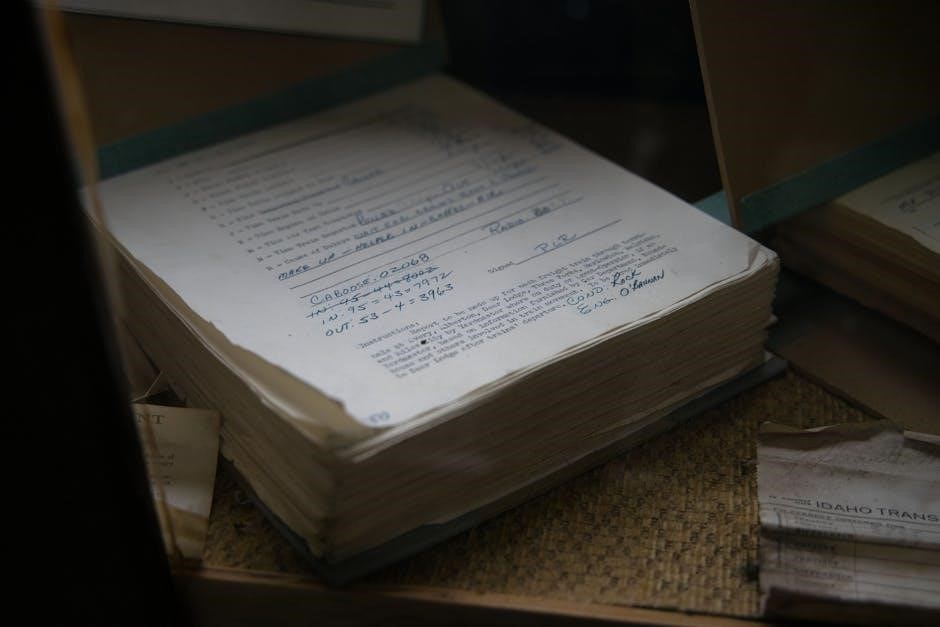
.DAT files originating from older software often present unique challenges for conversion to PDF due to a lack of documentation and support.
These files frequently store application-specific data, configuration information, or even serialized objects.
Attempting to open them with a simple text editor may reveal garbled or unreadable content, indicating a binary format.
Tools like 7-Zip, used in parse mode, might offer some insight into the file’s structure, potentially revealing recognizable data types.
Hex editors allow for manual inspection of the file’s raw bytes, but require a deep understanding of data representation.
Successful conversion often hinges on identifying the original application and its data format.
Without this knowledge, extracting meaningful information for a PDF becomes exceedingly difficult.
.DAT Files Associated with Specific Software
.DAT files tied to particular software necessitate understanding that program’s data handling methods for successful PDF conversion.
Often, these files aren’t standalone but integral components of a larger application’s ecosystem.
The software’s official documentation, if available, is the primary resource for deciphering the .DAT file’s structure.
Sometimes, the software itself offers export options to more common formats like TXT or CSV, facilitating conversion.
Look for utilities provided alongside the software, as mentioned in some cases, which may directly handle .DAT files.
Reverse engineering the software might be necessary if documentation is lacking, a complex undertaking.
Identifying the software is crucial; without it, conversion remains largely speculative and prone to errors.

Troubleshooting Conversion Issues
Conversion failures often stem from corrupted .DAT files, unsupported formats, or encoding errors; attempting 7-Zip parsing or a hex editor can help diagnose problems.
Handling Corrupted .DAT Files
Dealing with damaged .DAT files presents a significant challenge during PDF conversion. If a file appears corrupted, initial attempts should involve utilizing file repair utilities specifically designed for data recovery. However, success isn’t guaranteed, as the extent of the damage dictates recoverability.
7-Zip, in parse mode, might extract portions of the file even if it’s partially corrupted, potentially salvaging some data. A hex editor allows manual inspection, revealing patterns or recognizable data structures that could indicate the nature of the corruption.
If standard methods fail, consider if a backup exists. If not, the data may be unrecoverable, highlighting the importance of regular backups to prevent data loss. Attempting conversion with multiple tools is also advisable, as different programs handle errors differently.
Dealing with Unsupported File Formats
Encountering unsupported .DAT formats during PDF conversion is common, given the file type’s generic nature. Many standard conversion tools lack built-in support for the specific encoding or structure within a particular .DAT file. When this occurs, identifying the originating software is crucial.
Hex editors become invaluable for examining the file’s raw data, potentially revealing clues about its format. Programming approaches, like using Python, offer flexibility to parse the data based on discovered patterns.
If the format remains elusive, researching the software that created the .DAT file might uncover specific import or export functionalities. Online forums and communities dedicated to the software can also provide valuable insights and potential conversion solutions.
Addressing Encoding Errors
Encoding errors frequently arise when converting .DAT files to PDF, manifesting as garbled text or unreadable characters. This happens when the software attempting the conversion uses an incorrect character encoding. Identifying the original encoding is paramount.
Hex editors can help reveal encoding clues within the file’s header or data. Common encodings include ASCII, UTF-8, and various regional character sets. Experimenting with different encoding options in text editors or conversion tools is often necessary.
If the encoding remains unknown, attempting several common encodings and visually inspecting the output for readability is a pragmatic approach. Correctly identifying and applying the encoding is vital for a successful conversion.

Data Extraction and PDF Creation
Successfully opened .DAT files allow text extraction; utilize virtual printers to generate PDF documents, ensuring formatting and readability are maintained throughout the conversion process.
Extracting Text from Successfully Opened .DAT Files
Once a .DAT file is opened in a compatible viewer or text editor, the process of extracting its textual content can begin. However, the format of the extracted text will vary significantly depending on how the data was originally stored within the .DAT file.
Often, the text will appear as raw, unformatted data, potentially interspersed with control characters or binary code. Careful examination and cleaning may be required to isolate the meaningful text.
For files containing structured data, such as those from legacy applications, understanding the file’s internal organization is crucial for accurate extraction. Tools like 7-Zip, used in parse mode, can sometimes reveal the underlying structure, aiding in the extraction process.
After extraction, the text may need further processing to remove unwanted characters or reformat it for readability before creating a PDF.
Using Virtual Printers to Create PDFs
Virtual printers offer a universal solution for converting extracted text into PDF format, regardless of the application used to view the .DAT file’s content. After successfully opening and extracting text from a .DAT file, copy the content to the clipboard.
Open a text editor like Notepad (Windows) or TextEdit (macOS), paste the extracted text, and then select “Print.” From the printer list, choose a virtual PDF printer, such as “Microsoft Print to PDF” or “CutePDF Writer.”
Configure the printing settings as desired – page size, orientation, margins – and initiate the print process. The virtual printer will then prompt you to save the output as a PDF file, completing the conversion.
Ensuring PDF Formatting and Readability
PDF formatting after .DAT conversion often requires manual adjustments, as direct conversion rarely preserves original layouts. After creating the PDF, carefully review the document for readability issues like incorrect character encoding or missing fonts.
Utilize a PDF editor to correct any formatting errors – adjust font sizes, line spacing, and margins as needed. If the extracted text lacks structure, consider adding headings, lists, and paragraphs to improve organization.
For complex .DAT files, especially those from legacy applications, expect significant post-conversion editing. Prioritize clarity and ensure the PDF accurately represents the intended information.

Security Considerations
.DAT files may contain malware; scan them before conversion. Protect sensitive data during the process, and exercise caution with unknown files to avoid risks.
Scanning .DAT Files for Malware
Before attempting any conversion of a .DAT file to PDF, prioritizing security is paramount. Given their generic nature and potential origin from older or untrusted sources, these files can harbor malicious software. Employing a reputable antivirus or anti-malware scanner is a crucial first step.
Ensure your security software is updated with the latest virus definitions to maximize detection rates. Consider utilizing multiple scanning engines for a more comprehensive check. Online virus scanning services offer an additional layer of security, providing analysis from various vendors.
Be particularly cautious with .DAT files downloaded from the internet or received via email. Treat any file from an unknown source as potentially harmful until proven otherwise. A clean scan doesn’t guarantee complete safety, but significantly reduces the risk of infection during the conversion process.
Protecting Sensitive Data During Conversion
Converting a .DAT file to PDF necessitates careful consideration of data security, especially if the original file potentially contains sensitive information. Before conversion, assess the file’s origin and potential content to understand the risks involved. If the file is suspected to hold personal or confidential data, employ encryption methods during the PDF creation process.
Many PDF creation tools offer password protection and encryption features. Utilize these to restrict access to the PDF and prevent unauthorized viewing or modification. Consider redacting any particularly sensitive information before conversion, permanently removing it from the final document.
Always handle the .DAT file and the resulting PDF with appropriate care, storing them in secure locations and limiting access to authorized personnel only.
Best Practices for Handling Unknown .DAT Files
Encountering an unknown .DAT file requires a cautious approach before attempting conversion to PDF. First, scan the file with updated antivirus software to detect potential malware. Avoid directly opening the file with any application until its safety is confirmed. Isolate the file to prevent accidental execution or propagation of any malicious code.
Attempt to identify the file’s source or associated software. Examining the file’s metadata, if available, might offer clues. Utilize online resources and forums to search for information about similar .DAT files. If decryption seems necessary, proceed with extreme caution and only if a trusted decryption method is available.
Prioritize data safety and avoid hasty conversions.
No Responses